Narramblings #12: The platform is the message
Interactive storytelling via unusual media.
This essay first appeared in The Game Narrative Kaleidoscope, a collection of 100+ articles on the craft of game writing collated by Jon Ingold. If you enjoy it, make sure to grab a copy.
There are few more enduring nuggets of wisdom than Marshall McLuhan’s classic the medium is the message. I’m reminding you of this well-worn adage to talk about how platforms and systems we don’t often associate with storytelling can be used as narrative media.
Spoilers ahead! For: Lifeline, Thousand Lives
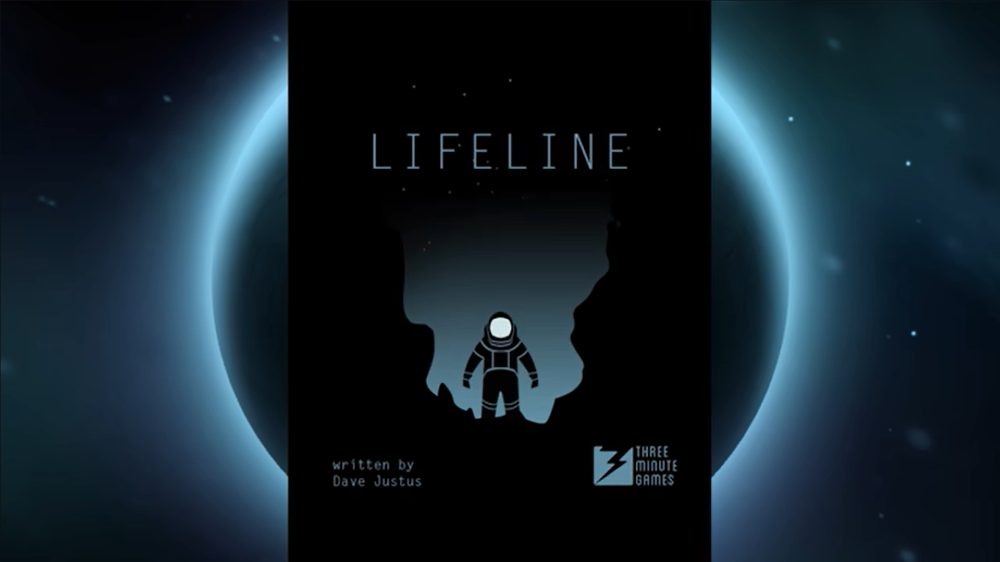
Take Lifeline, a text-based game released on mobile by 3 Minute Games in 2015. It tells a story of Taylor, an astronaut stranded after crash-landing on an unknown planet. Taylor contacts you - the player - and asks for help. The entire gameplay is made up of text formatted to look like a message feed, a little bit of background music, and binary choices for what you can suggest to Taylor: sleep outside/in the wreckage, rest/keep going, etc. It very easily could have been a fairly standard text game. People would beat it in an hour or so, think that was neat, and move on.
But that’s not how Lifeline works.
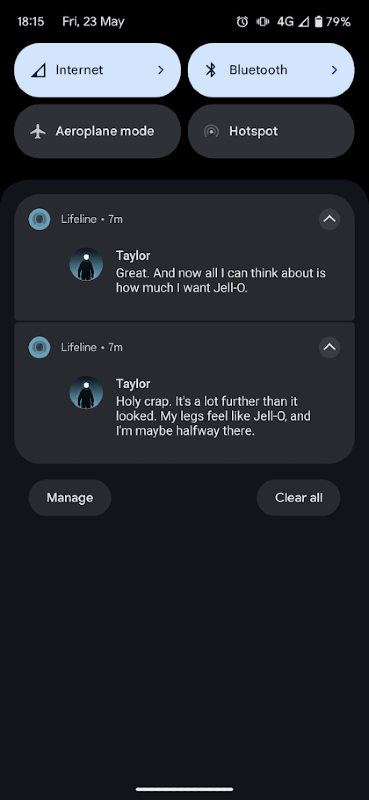
It tells its story by employing a system built into mobile platforms: push notifications. Because the plot unfolds as a feed of messages between you and Taylor, this makes perfect sense. It also turns the passage of time in the real world into a gameplay mechanic. When you tell Taylor what to do next - stay or go, eat the last of their supplies or save them but stay hungry - you don’t find out the result immediately. Depending on the action, it could be minutes or hours until you learn whether your advice killed the main character or saved their life. So when your phone buzzes and you see a notification from Lifeline, adrenaline hits immediately.
Waiting creates tension that wouldn’t otherwise be present. And receiving messages from the game’s main character breaks the fourth wall in a way that brings you deeper into the story. Tying together push notifications, conversation-based interface, and real-world passage of time creates a game that’s much more than the sum of its parts. Even though text-based, it is experienced rather than read.
I took a whole lot of inspiration from Lifeline when I created Thousand Lives (which can, AND SHOULD, play here for free). It’s a piece of interactive fiction following the life of a woman born in Communist Poland, meant as a reflection on how we’re sometimes forced to make choices that define our future but never given a chance for a do-over. That naturally required a lot of branching, so there are 32 possible endings. But I wanted the story itself to be only part of the experience. I wanted playing Thousand Lives to actually feel like following someone else’s entire life. And it doesn’t quite work if you can do it in one sitting or go back when you don’t like the outcome.
I needed a way to simulate the passage of years and to make the choices irreversible. Inspired by what Lifeline did with push notifications, I eventually settled on using another system that’s seldom employed for interactive storytelling.
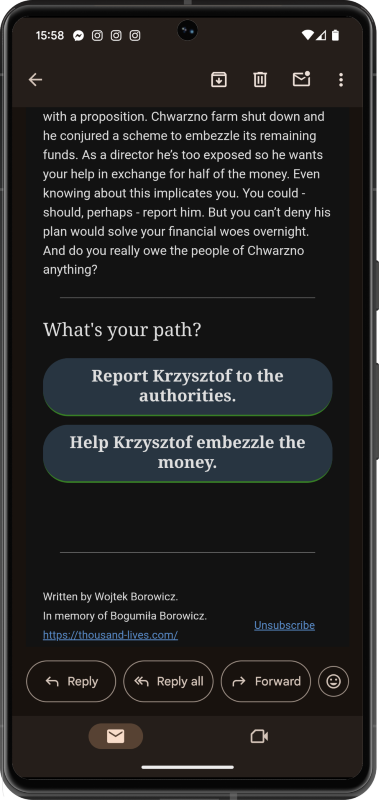
Thousand Lives plays out entirely in your email inbox. Once a day you receive a new chapter, covering about a decade of the story and ending with a binary choice. Will you go to work in the shipyard or leave your hometown? Do you want to join the Communist Party to get your father out of prison or continue protesting against the government? Are you going to keep the baby? Each choice fundamentally alters the trajectory of the main character’s life and each time you need to wait another 24 hours for the next chapter. Therefore, even though a single playthrough has roughly 15 minutes worth of reading, it takes a week to complete Thousand Lives. The delay between chapters simulates the time passing in the story and creates a very different experience than if you just clicked through all of it on your lunch break. And since the player’s progress is tied to their email address, they cannot go back to try other paths. Just like in real life, choices are final. All of that is achieved thanks to using email as the platform.
Lifeline and Thousand Lives use platforms’ features in somewhat similar narrative systems. The former was an inspiration for the latter, after all. But you can go far beyond that. Zombies, Run! uses a phone’s built-in accelerometer to track how much distance you’ve covered in the real world and tie it to traversal in the fiction, full of zombies trying to catch up and eat your brain. Neurocracy exists at the intersection of Wikipedia and an internet forum. Pokemon GO is built on actual location data and while it’s not a narrative game, it doesn’t take a big leap of imagination to see how its systems could be used for storytelling.
The platform you choose to tell the story is as important to the experience as the story itself. And now that we’re surrounded by software (which sure has a certain dystopian flavour, but that’s a whole other conversation), this opens up more possibilities for building unique narrative systems than ever before. Use that! Go wild with geofencing, spreadsheets, cameras, wikis. Everything is a platform. And the platform is the message.
Before this was an essay, it was a talk I gave at NarraScope in 2025. You can watch it below. And don't forget to register for NarraScope 2026 for all things narrative from a host of great speakers (and yours truly).